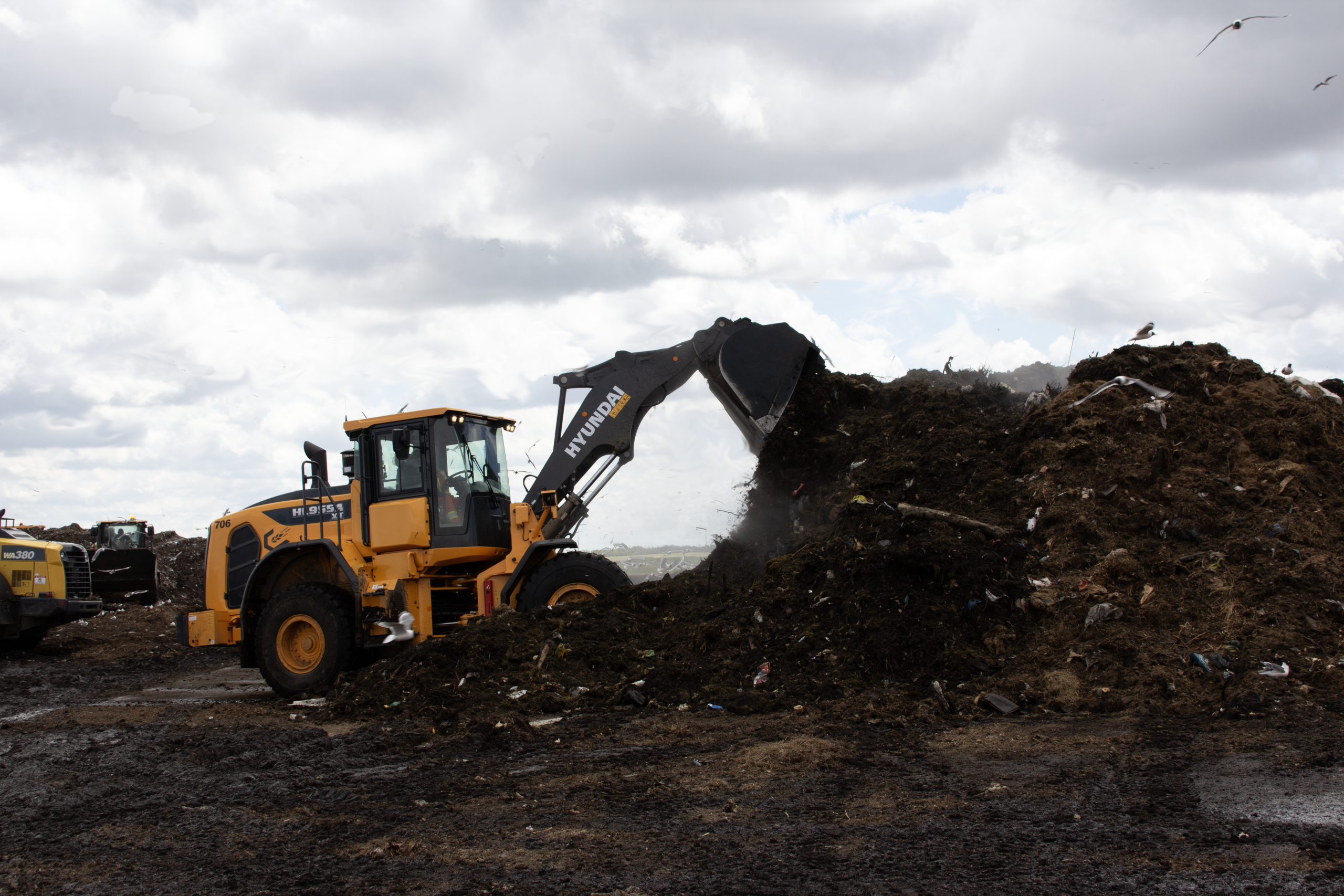
Most of the odour complaints we receive – or hear about on social media – are blamed on our compost facility. The odours are usually described as putrid, rotten, and nauseating, and are lingering for a significant period of time. While there have been situations where there has been an odour release following a mechanical malfunction in our compost facility, or a delivery of particularly noxious organic material, it is unusual for a properly functioning compost facility to give off noxious odours for an extended period of time.
Commercial composting
The first thing to know about composting on a commercial scale is that there are two main methods for the breakdown of organic material:
- Aerobic (with oxygen)
- Anaerobic (without oxygen)
Claystone has an aerobic facility that utilizes an advanced Aerated Static Pile (ASP) composting system. This system breaks down organic materials quicker and produces fewer harmful emissions and methane. The entire process at Claystone focuses on maintaining an aerobic state.
Composting is a science, with many aspects that need to be at the right balance to function properly. This includes assessing the type and size of organic waste (e.g. food waste or yard waste), weather conditions, pore space, volume and type of amendment required to adjust the ratio of carbon to nitrogen size of the pile, moisture levels, and the volume of aeration. If any of these are off, the result can be the release of odours. Claystone regularly monitors and refines all these factors to keep the piles in an optimal decomposition state.
Organic processing
The organic material that comes into our facility is immediately mixed with wood chips to help ensure air circulation, and the piles are covered with a biocover made up of wood chips, finished compost, and screenings. This biocover acts as a filter to minimize odours escaping the pile through absorption. There may be short releases when turning piles, but this is considered part of normal composting operations.
When organic material is composting properly, it will have little odour. Any odour present would be pleasant and smell like soil or wood and are generally contained within the compost facility.
Odour incidents
Compost odours often occur when organic material is being delivered to the site or if the composting process has moved into an anaerobic state due to a breakdown of the materials in an oxygen-free environment.
In August of 2024 and June of 2025, Claystone experienced significant mechanical failures in our composting facility – specifically the blowers that are to keep the piles oxygenated. These failures caused the piles to go into an anaerobic state, resulting in extended odour releases that were described as putrid, like rotten fruit or eggs.
Since replacing the faulty equipment, Claystone has been able to maintain a balance of oxygen, temperature, moisture, etc., to ensure optimal decomposition and minimal odours.
If everything is working, why are people smelling rotten compost now?
The simple reason for the foul odours associated with aerobic composting is this: not all organics go to the Claystone composting facility.
Trucks hauling to the landfill are often bringing in loads containing organic material including Municipal Solid Waste (MSW) – otherwise known as garbage. This can be any combination of household waste, commercial waste, and institutional waste, and will often contain some organic material (e.g. food waste, yard waste, animals, septic, etc.).
Landfill material containing organic waste will often create odours as – unlike compost facilities – air is not blown into loads going in the landfill. This means the organic waste being buried in the landfill is decomposing with limited oxygen. As a result, it will create odours similar to what we experienced when we had mechanical issues at the compost facility.
When this combination of waste is dumped at the landfill, our crews will work as quickly as possible to process that waste and place a cover to reduce scattering of debris, limit access to wildlife, and to help contain odours.
However, landfilling waste means that it will transition from an aerobic to an anaerobic state over time. Once all the available oxygen is consumed by bacteria, the landfill becomes anaerobic and can begin to produce landfill gas that can be collected and upgraded to generate electricity or renewable natural gas.
As outlined earlier, organics decomposing in an anaerobic state are going to cause odours. This means that, unless there is a failure within our composting facility, any unpleasant organic odours are most likely from the organics in the landfill.
Why haven’t we smelled the landfill before?
As Claystone only started composting operations in 2023 and given the issues with mechanical breakdowns and particularly odorous organic material brought to our site, people have attributed any foul smell to composting.
Although we have tried to explain the odours are coming from the landfill, many have stated that they didn’t smell the landfill before, so how could it be a problem now.
The short answer: the landfill is changing.
First, the current footprint is consuming the last of its available airspace. This means that waste is being put into the landfill at higher altitudes, increasing opportunities for odour molecules to be picked up and carried by the wind. This would include the odours of decomposing organic material dumped at the landfill.
Second, weather conditions also impact the chemistry of the landfill. Rain, summer heat, and freeze/thaw from daily temperature fluctuations in spring and fall will increase the likelihood of the landfill releasing odours.
Finally, as happens to all landfills, our landfill is maturing and the way waste is broken down is changing. It’s a complex process, but in a nutshell, here’s what happens:
- Aerobic bacteria initially consume the waste.
- As oxygen is consumed, anaerobic bacteria, which thrive in the absence of oxygen, will take over.
As discussed earlier, anaerobic decomposition of organic matter will cause more odours.
This evolution of a landfill does not occur overnight. Time – meaning decades – and the availability of moisture in the landfilled waste are the largest variables that impact the time it takes for a landfill to become anaerobic and eventually become a steady state facility.
If you’re curious to know more about the science of a maturing landfill, we highly recommend this scientific paper, “Microbial methane cycling in a landfill on a decadal time scale.” Microbial methane cycling in a landfill on a decadal time scale – PMC